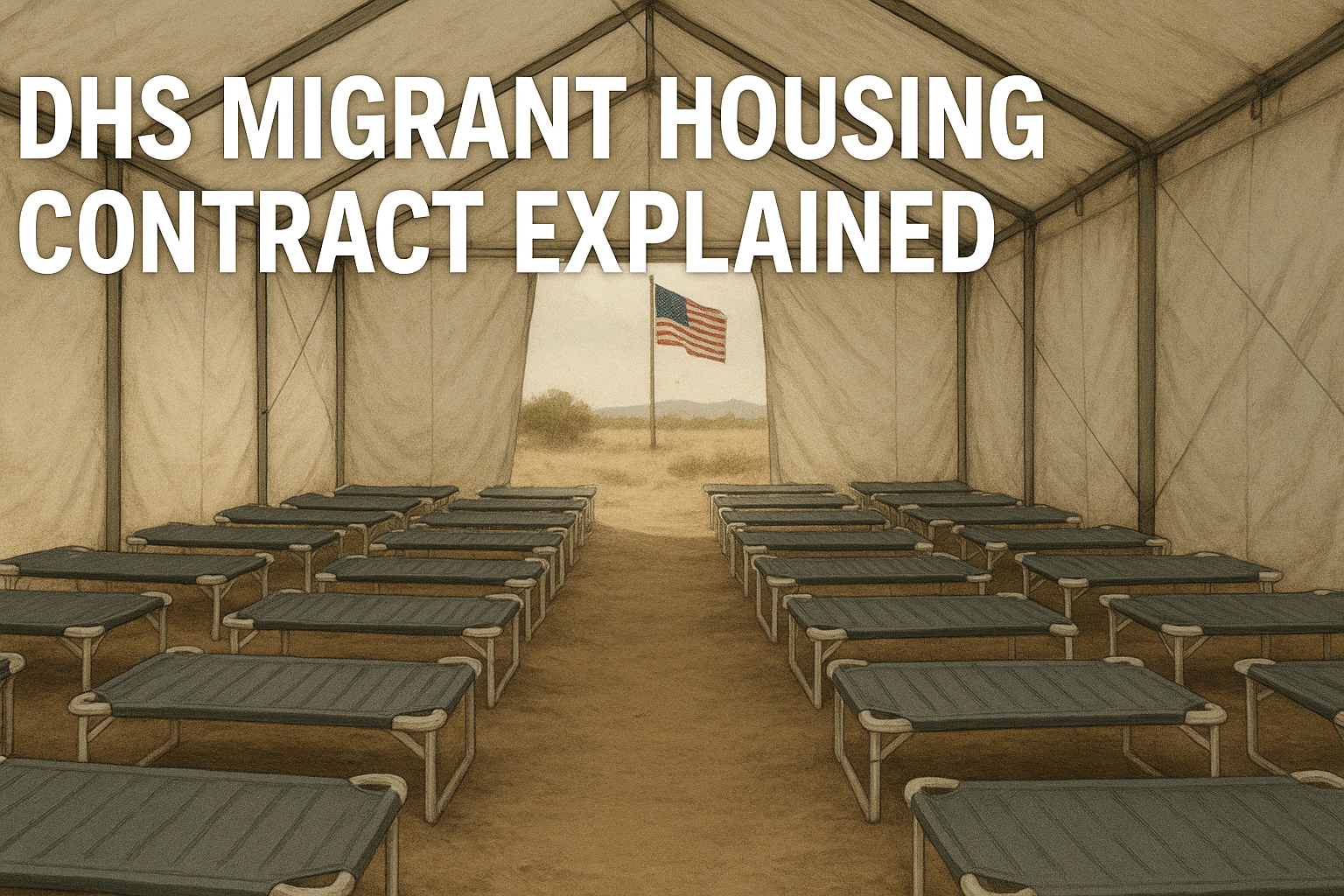
You may have searched for “doge hhs migrant housing contract” and ended up confused. Is it about cryptocurrency? A joke? A federal scandal?
The reality is far more serious—and not at all related to Dogecoin.
This phrase refers to a controversial government contract connected to the Department of Health and Human Services (HHS) and the care of unaccompanied migrant children. The controversy intensified after the Department of Government Efficiency (DOGE)—a newly formed federal body—terminated the contract, claiming massive taxpayer savings.
This article will lay out only verified facts about what happened, who was involved, and what it means for U.S. immigration policy, federal procurement, and human rights. All unverified claims will be clearly marked.
What Was the HHS Migrant Housing Contract?
Overview
In 2021, the U.S. experienced a sharp increase in unaccompanied minors crossing the southern border. These children, by law, are transferred from Customs and Border Protection (CBP) to the Office of Refugee Resettlement (ORR), part of HHS, which is responsible for their shelter, care, and placement.
To manage this surge, HHS created Emergency Intake Sites (EIS): temporary shelters set up quickly, often through no-bid or sole-source contracts under emergency powers.
One of the largest of these contracts was awarded to Family Endeavors, a nonprofit based in San Antonio, Texas. This contract became a major political issue in 2024–2025, culminating in its termination by the DOGE agency.
Who Is Family Endeavors?
Family Endeavors is a nonprofit organization founded in 1969. It has experience working with homeless veterans, disaster recovery programs, and support services for vulnerable populations.
Contract Details
-
Recipient: Endeavors, Inc. (doing business as Family Endeavors)
-
Awarding Agency: U.S. Department of Health and Human Services (HHS), Office of Refugee Resettlement (ORR)
-
Contract Purpose: Operate large-scale Emergency Intake Sites (EIS) for unaccompanied migrant children
-
Award Type: Sole-source (non-competitive), justified under emergency procurement authority
-
Estimated Value: Approximately $530 million
-
Facility Location: Pecos, Texas (among others)
-
Term: Active operations began in 2021, with readiness payments continuing into 2024
This was, at the time, the largest single federal contract ever awarded to Family Endeavors.
What Did the Contract Pay For?
The Pecos facility—one of several operated by Family Endeavors—was designed to house up to 3,000 children at a time. During periods of high migration, the facility reached full or near-full occupancy.
However, when migration levels declined in 2023 and 2024, the site remained mostly empty. Despite this, the federal government continued to pay millions per month under what’s known as a “cold status” readiness agreement.
These payments covered:
-
24/7 staff retention
-
Facility leasing and maintenance
-
Security
-
Food and medical supplies kept on standby
-
Health and safety compliance
Verified monthly payments during inactivity were estimated at $18 million per month, according to public budget records.
What Is the Department of Government Efficiency (DOGE)?
The Department of Government Efficiency (DOGE) is a newly created federal agency launched in early 2025. It is not a cryptocurrency project, despite the name.
DOGE was tasked with auditing and terminating federal contracts it deemed wasteful or duplicative. It operated across multiple departments, including HHS, Department of Defense, and others.
The DOGE X account (formerly Twitter) publicly announced contract cancellations and posted savings claims. One of its most high-profile actions was the termination of the Family Endeavors contract at Pecos.
Why Was the Contract Canceled?
DOGE and HHS jointly terminated the contract in March 2025. Reasons cited included:
-
Declining migrant arrivals
-
Sustained under-occupancy of the shelter
-
High ongoing maintenance costs
-
Shift in federal migrant housing strategy
DOGE claimed the termination would save $215 million annually.
Important Clarification
🔎 This figure is based on projected future savings, assuming continued payments at the same rate. It is not a reclaim of already spent funds. ([Verified])
Family Endeavors’ Response
Family Endeavors released public statements denying any wrongdoing or waste.
Key points in their defense:
-
They followed all contractual terms.
-
Readiness payments were structured and approved by ORR.
-
The facility had successfully housed over 40,000 children between 2021 and 2023.
-
The nonprofit had no role in deciding occupancy rates—that was up to federal immigration flows.
They also stated that the contract’s termination should not imply misconduct.
🔎 There is no verified evidence that Family Endeavors violated contract terms. ([Verified])
Legal and Oversight Status
As of this writing:
-
No criminal investigations have been launched into Family Endeavors.
-
The HHS Inspector General had previously flagged general concerns about EIS contracts but did not single out Endeavors in any wrongdoing. ([Verified])
-
Multiple federal watchdogs and media outlets have called for greater transparency in emergency contract awards and readiness payments.
What Is “Cold Status” and Why Was It Expensive?
When migration ebbed, HHS kept several EIS facilities on “cold status”—a contract state where facilities are ready to activate within 48–72 hours if needed.
Reasons for high standby costs include:
-
Full staff retention
-
Compliance with federal shelter and child welfare laws
-
Monthly lease payments for large physical infrastructure
-
Security personnel and surveillance systems
-
Maintenance of food, water, and medical stockpiles
🔎 These cost structures are standard in emergency management, including FEMA disaster housing and military mobilization contracts. ([Verified])
Data Access and Privacy Concerns
After DOGE’s involvement, it was revealed that staff affiliated with the agency had been granted access to 19 HHS systems, some containing personally identifiable information (PII) of migrant children and sponsors.
This raised major concerns among:
-
Civil rights advocates
-
Immigration lawyers
-
Former HHS officials
Concerns centered on whether this access:
-
Violated HIPAA or ORR privacy safeguards
-
Could lead to misuse of sensitive data for unrelated enforcement
-
Undermined trust in family reunification systems
As of now, no confirmed data breach has been reported. However, litigation has been filed by at least two organizations to challenge DOGE’s access to sensitive systems. ([Verified])
Broader Context: Were Other Contracts Cancelled?
Yes. According to watchdog outlet HigherGov, DOGE terminated more than 9,000 contracts across various federal agencies. The total estimated ceiling value of these contracts was around $71 billion.
However, verified spending prior to termination was often significantly lower than DOGE’s stated savings.
🔎 Independent audits found that DOGE’s savings claims sometimes included unspent or already expired contract funds, leading to inflated totals. ([Verified])
What Are the Long-Term Policy Effects?
The termination of the Family Endeavors contract has prompted:
-
Congressional hearings into federal emergency procurement
-
Bipartisan calls for more competitive bidding—even in emergencies
-
New proposals to require third-party audits of migrant housing contracts
-
Increased scrutiny of nonprofits managing large-scale federal operations
Advocates have urged that any reform must not compromise the care and safety of migrant children, especially those fleeing violence or persecution.
Read Also: Jacksonville Flight Discontinuations: Route Cuts and Recovery Efforts
Conclusion
Here is what we know for certain about the so-called “doge hhs migrant housing contract”:
-
The contract was real, not a meme or crypto hoax.
-
It was awarded to Family Endeavors by HHS to manage migrant child housing.
-
Payments continued even when the facility was empty, due to readiness clauses.
-
It was terminated in 2025 by DOGE citing taxpayer savings.
-
No wrongdoing has been proven against Family Endeavors.
-
Privacy and oversight issues remain a concern, particularly regarding data access.
The story reveals how emergency responses—however well-intentioned—can lead to unintended financial and political consequences. It also shows that accountability does not end when a contract is signed. It begins there.