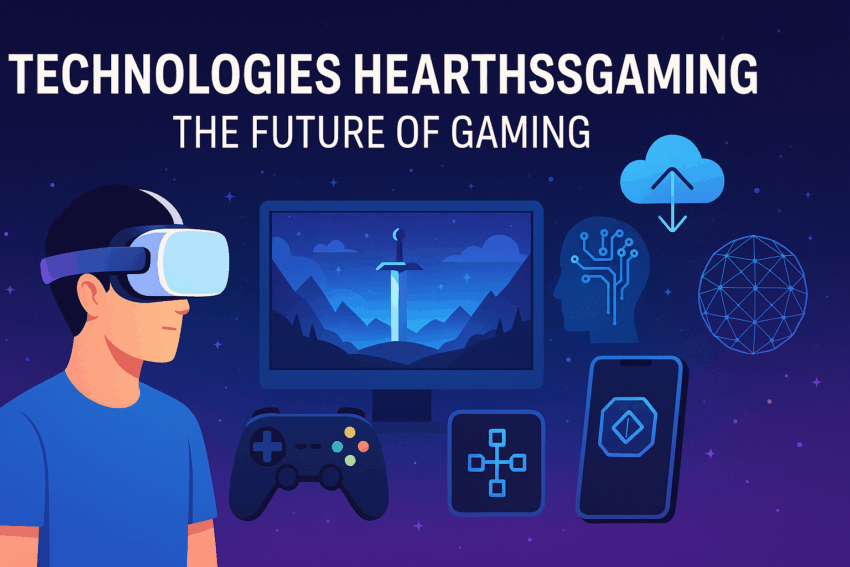
Gaming has never been static. From the early 8-bit sprites that hopped across arcade screens to today’s hyper-realistic, immersive universes, technology has shaped every leap forward. Now, a new concept—Technologies Hearthssgaming—is emerging as the phrase that captures the most transformative forces driving the next generation of play.
This isn’t just about better graphics or faster processors. Technologies Hearthssgaming is a shorthand for the convergence of multiple innovations—artificial intelligence, cloud infrastructure, blockchain, cross-platform ecosystems, virtual and augmented reality, and advanced network architecture—that together make gaming more immersive, inclusive, and intelligent than ever before.
By 2025, gaming has become a $250+ billion global industry (Statista, 2024). Analysts predict it will surpass $320 billion by 2026, fueled by both technological breakthroughs and a cultural shift where games are not merely entertainment but hubs of education, commerce, and social connection. Understanding Technologies Hearthssgaming means understanding the technological DNA of this massive, living organism.
Defining Technologies Hearthssgaming
At its core, Technologies Hearthssgaming represents the backbone of interactive entertainment today. Think of it as the “hearth”—the central fire—around which players gather, powered by an ecosystem of interlinked technologies that sustain gameplay, immersion, and global connectivity.
The key components include:
-
Artificial Intelligence (AI): Procedural generation, adaptive difficulty, natural-language NPCs.
-
Virtual & Augmented Reality (VR/AR): Full immersion or digital overlays enhancing real environments.
-
Cloud Gaming Infrastructure: Streaming games from remote servers, lowering hardware barriers.
-
Blockchain & Digital Ownership: Secure, player-owned economies with NFTs and tokenized items.
-
Cross-Platform Play: Seamless gaming across PC, console, and mobile.
-
Real-Time Networking: 5G and edge computing powering low-latency experiences.
Each pillar alone is impressive. Together, they form the Hearthssgaming ecosystem—making games not just richer but also socially and economically transformative.
A Short History: From Pixels to Persistent Worlds
1980s–1990s: The Arcade to Console Shift
Arcades dominated the 1980s. Games like Pac-Man and Street Fighter used relatively primitive chips but introduced multiplayer competition and fast reflex gameplay. By the 1990s, home consoles (PlayStation, Nintendo 64, Sega Dreamcast) emphasized 3D rendering, ushering in worlds with depth.
2000s: The Rise of Online Play
Broadband adoption allowed MMORPGs (e.g., World of Warcraft) and competitive shooters (Halo 2, Counter-Strike) to flourish. The idea of “persistent online identities” became central.
2010s: Mobility and Streaming
Smartphones placed games into billions of pockets. Meanwhile, Twitch and YouTube Gaming made watching others play almost as big as playing itself. Cloud gaming prototypes like OnLive hinted at hardware-free futures.
2020s–Now: Immersion and Ownership
The convergence of AI, VR/AR, blockchain, and hyper-connectivity turned gaming into something that is part entertainment, part economy, part social infrastructure. Technologies Hearthssgaming is shorthand for this convergence.
Core Technologies Driving Hearthssgaming
Artificial Intelligence (AI)
AI powers more than enemy pathfinding. Today, it enables:
-
Procedural world generation: Titles like No Man’s Sky use AI to generate billions of unique planets.
-
NPC realism: Natural-language processing allows characters to hold conversations that feel human.
-
Adaptive gameplay: Systems adjust difficulty dynamically, keeping games engaging without overwhelming players.
According to a 2023 McKinsey study, 60% of major game studios now integrate AI tools for world-building and story design.
Virtual & Augmented Reality
VR immerses; AR enhances. Together they are expanding play:
-
VR gaming (Half-Life: Alyx, Beat Saber) places players inside story worlds.
-
AR overlays (Pokémon Go, AR glasses prototypes) turn sidewalks into battlefields or classrooms.
-
Haptic suits and gloves amplify sensory input, letting you “feel” sword clashes or raindrops.
The VR/AR gaming market is projected to reach $45 billion by 2027 (PwC, 2024).
Cloud Gaming Infrastructure
Platforms like Xbox Cloud Gaming, GeForce Now, and PlayStation Plus Premium demonstrate that the future of gaming does not require expensive consoles. Instead, GPU-intensive work is handled by servers, streaming frames to any device.
-
Benefits: Lower hardware costs, instant access to libraries, cross-device continuity.
-
Challenges: High bandwidth requirements, latency in regions with poor connectivity.
Cloud gaming subscriptions surpassed 50 million global users by 2024, doubling from 2022 (Newzoo, 2024).
Blockchain & Digital Ownership
Controversial but significant, blockchain introduces:
-
Verifiable digital assets (NFTs): Skins, weapons, or land parcels that can be owned, traded, or monetized.
-
Play-to-earn models: Games like Axie Infinity pioneered reward economies, albeit with volatility.
-
Decentralized marketplaces: Peer-to-peer item exchanges without corporate gatekeepers.
A Deloitte survey in 2024 found 32% of Gen Z gamers express interest in “earning while playing,” though concerns over speculation and sustainability remain.
Cross-Platform & Social Connectivity
Cross-platform play breaks silos:
-
Fortnite and Minecraft allow friends across PC, console, and mobile to collaborate.
-
Social features like in-game chat, streaming integration, and community hubs blur gaming and social networking.
According to ESA (2024), 65% of gamers in the US now identify multiplayer or social interaction as their main reason for playing.
Networking & 5G
Real-time multiplayer requires speed. 5G networks reduce latency to milliseconds, while edge computing processes data closer to users. The result: smoother VR sessions, near-instant competitive responses, and large-scale events with thousands of simultaneous participants.
Benefits of Hearthssgaming for Players
-
Immersion: Worlds feel alive, senses are engaged.
-
Accessibility: Cloud lowers hardware barriers; free-to-play models expand reach.
-
Ownership: Blockchain gives players real stake in their virtual goods.
-
Social Bonds: Cross-platform play builds communities across geography.
-
Dynamic Challenge: AI tailors games to your skill curve.
Challenges & Concerns
-
Cost of Equipment: VR headsets, haptics, and reliable broadband remain expensive.
-
Digital Divide: Players in regions with weak infrastructure are excluded.
-
Health Concerns: VR motion sickness, screen addiction, sedentary lifestyle issues.
-
Ethical Issues: Data privacy, AI-driven manipulation, blockchain speculation.
-
Environmental Impact: Energy consumption of blockchain and cloud data centers.
Future Trends
-
Metaverse Integration: Persistent virtual spaces merging work, play, and commerce.
-
Haptic Feedback Advances: Full-body suits offering realistic sensations.
-
AI Game Masters: Real-time story adaptations personalized to every player.
-
Sustainable Gaming Tech: Renewable-powered servers, carbon-neutral blockchain.
-
Educational Expansion: Gamification of training, medicine, and corporate learning.
FAQs
What is Technologies Hearthssgaming?
It’s the collective term for technologies—AI, VR, AR, cloud, blockchain, and networking—that power modern gaming ecosystems.
Is it only for entertainment?
No. Applications include education, healthcare simulations, military training, and professional collaboration.
Will blockchain dominate gaming?
It will play a role, but balanced models are needed to avoid speculation pitfalls.
Do I need expensive gear?
Not always—cloud gaming allows access with modest devices.
Is this the future of esports?
Yes. AI referees, VR spectator modes, and global cloud infrastructure are already reshaping competitive play.
Read Also:
Conclusion
Technologies Hearthssgaming is more than jargon—it’s the living ecosystem at the core of modern gaming. By weaving together AI, VR, AR, blockchain, and cloud infrastructures, it delivers richer worlds, stronger social ties, and new economic opportunities.
Yes, challenges exist—from accessibility gaps to ethical debates—but the direction is clear: gaming is not just about play anymore. It is about participation in digital futures. The hearth is lit, the technologies are advancing, and the game is only beginning.